

Dear Burned Out Black Girl,
There is a particular kind of exhaustion that comes from constantly editing yourself.
You soften your honesty so nobody calls you angry. You make your needs smaller so nobody calls you difficult. You remain helpful, pleasant, productive, and emotionally available because you understand that the world is often more comfortable with a Black woman’s labor than her full humanity.
Nina Simone and Eartha Kitt were two very different women, but they shared a refusal to become small enough for the world to comfortably consume them.
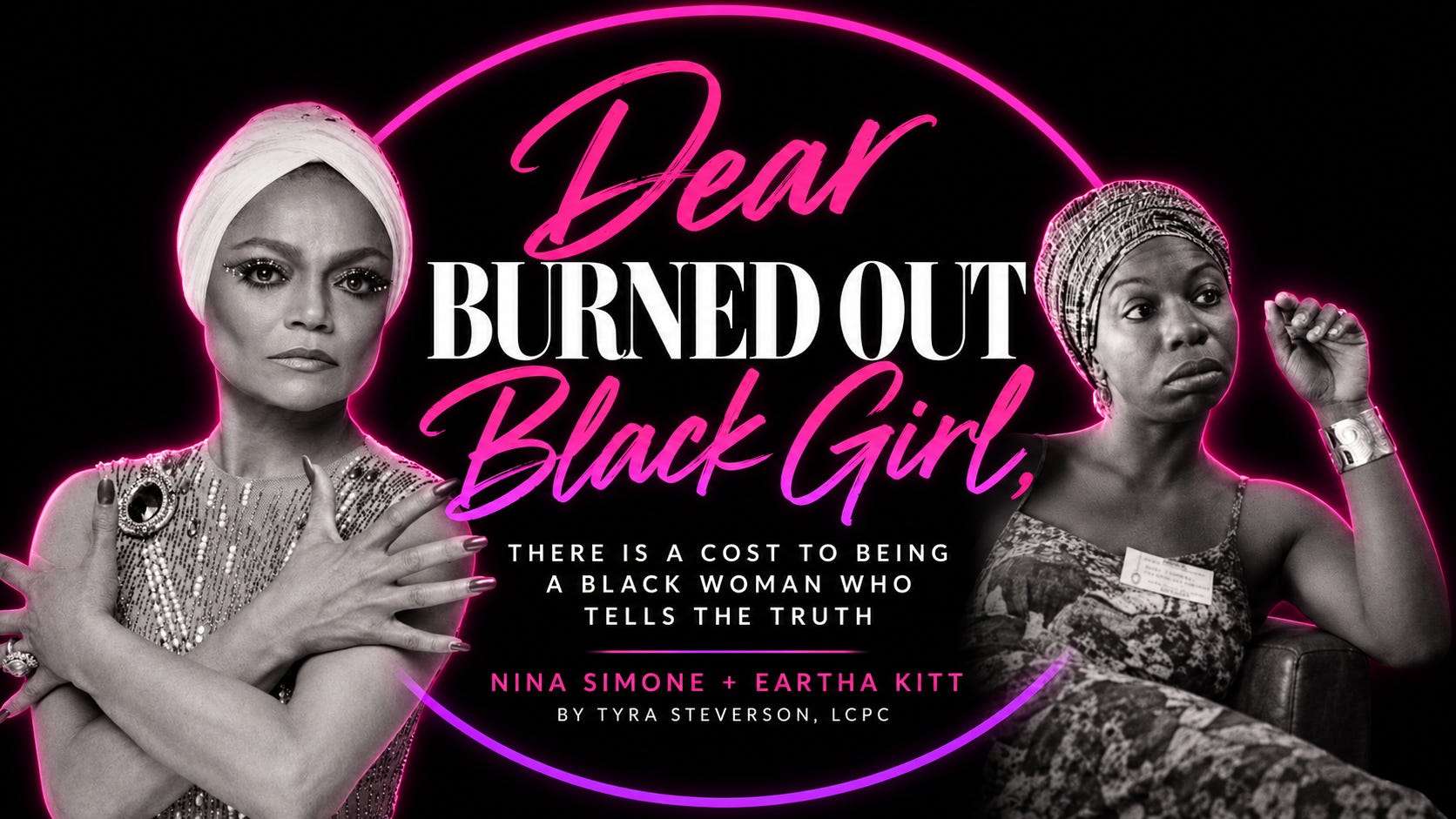
Nina Simone carried classical precision, gospel intensity, blues sorrow, jazz improvisation, and political protest inside the same body of work. As the Civil Rights Movement intensified, her music became increasingly direct about racism, Black identity, grief, rage, and freedom.
Eartha Kitt transformed herself across music, dance, theater, film, and television. She became known for her sensuality, wit, unmistakable voice, and commanding presence. But when she spoke against the Vietnam War during a 1968 White House luncheon, the consequences reached beyond disagreement. Her American career suffered because she told the truth in a room that expected her to entertain, not confront power.
That is a familiar position for Black women.
People celebrate our voices until we use them to say something inconvenient.
They praise our strength until that strength becomes a boundary. They admire our intelligence until we question the system. They love our confidence until it prevents them from controlling us.
Nina and Eartha reveal something important about burnout: sometimes we are not exhausted because we lack strength. We are exhausted because we have spent too much strength maintaining environments that require our silence.
The World Will Exploit What It Praises
Black women are constantly praised for our capacity.
We can run the business, raise the children, support the partner, serve the community, solve the crisis, mentor the younger woman, answer the phone, lead the meeting, remember the birthday, and still make it look beautiful.
People call that strength.
But praise can become permission.
Once people decide that strength is who you are, they begin treating support as something you do not need. They assume that because you handled something well, it did not hurt. They confuse what you are capable of doing with what they are entitled to receive from you.
Nina Simone’s range was extraordinary. Eartha Kitt’s ability to continually reinvent herself was extraordinary.
But extraordinary capacity does not erase human limitation.
Talent does not cancel the nervous system. Purpose does not eliminate the need for care. Strength does not make neglect acceptable.
Your capacity is a resource.
It is not your identity, and it is not a debt you owe the world.
Your Anger May Be Telling the Truth
Both women disrupted the expectation that a Black woman’s primary responsibility is to remain pleasant.
Nina allowed rage to enter her music without cleaning it up for public comfort. Eartha spoke directly to power, even when the room wanted charm and gratitude.
Neither woman made honesty look harmless.
That matters because Black women are often taught to distrust our anger. We are expected to make our disappointment gentle, our pain educational, and our boundaries easy for other people to receive.
By the time we finish translating our truth, we can barely recognize it.
But anger is not always evidence that something is wrong with you.
Sometimes anger is the part of you that has finally stopped cooperating with what is wrong around you.
It may be telling you that the relationship is unequal. The responsibility is unreasonable. The opportunity is exploitative. The pace is unsustainable. The support is performative. The version of you everyone celebrates is slowly destroying the woman underneath it.
Burnout is often grief and anger that have been forced to become productivity.
You Were Somebody Before You Became Useful
Before Nina Simone became a civil rights icon, she was Eunice Kathleen Waymon, a gifted little Black girl who loved the piano.
Before Eartha Kitt became an international performer, she was a child who survived poverty, rejection, instability, and questions surrounding her identity.
We remember what these women produced because their work became part of our culture. But before the music, performances, beauty, courage, and legacy, there were two human beings trying to belong to themselves.
Black women are too often remembered according to what we gave after the world encountered us.
Our usefulness becomes our biography.
People celebrate the company, the children, the ministry, the movement, the patients, the clients, the family, or the village we held together. Then they forget there was a person here before the assignment.
You were somebody before you became useful to everybody.
You had preferences before you became the dependable one. You had limits before people punished you for having them. You had curiosity, softness, pleasure, appetite, and possibility before your life became a list of things that could not fall apart.
Burnout does not only come from doing too much.
Sometimes it comes from disappearing inside what you do well.
Freedom Must Include the Woman Creating It
Nina Simone’s music became part of the soundtrack of Black freedom.
Eartha Kitt’s life demonstrated the freedom of refusing to surrender her mind in exchange for continued approval.
But their lives also leave us with a difficult question:
What does freedom mean if everybody is liberated except the woman doing the liberating?
What is the point of building a successful business if its owner is chronically unavailable to herself?
What is the point of maintaining a family if one woman’s body must remain in crisis to hold it together?
What is the point of being the village if the village only recognizes you as infrastructure?
We have inherited beautiful traditions of service, faith, care, ingenuity, and collective responsibility.
We have also inherited the dangerous belief that love is proven through depletion.
It is not.
Love may include sacrifice, but it cannot require your permanent disappearance. Purpose may demand courage, but it should not require you to stop being a person. A calling that leaves no room for your body, joy, limitations, relationships, or humanity has been distorted somewhere along the way.
Let Their Legacies Become Permission, Not Pressure
We do powerful Black women a disservice when we reduce them to evidence that greatness is possible.
Nina Simone and Eartha Kitt were not placed on earth merely to motivate us to work harder.
Their lives are not additional standards against which we should measure our productivity.
Their legacies give us permission to be complex. To refuse easy categories. To evolve beyond the version of ourselves other people find most profitable. To tell the truth with beauty and tell it again without beauty when beauty would dilute it.
They remind us that dignity is not something an audience, employer, partner, institution, or family gets to award us after we have performed well enough.
Your worth does not increase when you endure more.
Your humanity does not become negotiable because you are talented.
Your needs are not proof that you lack discipline.
Your limits are not a betrayal of your calling.
You are allowed to create without becoming consumed by your creation. You are allowed to serve without volunteering to be sacrificed. You are allowed to change the world and still want a life that feels good to live.
Nina Simone and Eartha Kitt did not leave us instructions for perfect living.
They left us evidence of self-possession.
Evidence that a Black woman can be sensual without being submissive. Political without asking permission. Brilliant without performing agreeability. Wounded without surrendering her voice.
Maybe healing from burnout begins when you stop asking, “How much more can I carry?” and ask a better question:
“What deserves access to me?”
Not everything that needs to be done needs to be done by you. Not everyone who benefits from you is entitled to you. Not every emergency belongs in your body. Not every opportunity deserves your yes. Not every version of success is worthy of your life.
You are not a machine covered in spiritual language.
You are not the emergency contact for the entire world.
You are not valuable because you can function while hurting.
You are a whole woman whose work may be powerful, whose capacity may be immense, and whose life still belongs to her.
You have nothing left to prove through exhaustion.
i loved every minute of this. it allows for us black women to feel without feeling guilty of being exhausted or whatever else. this piece acknowledges the complexities & contradictions of being a black woman but still depicts are beauty & vulnerability through it all. we are not an perception to entertain, an image to uphold but an actual human being