

I didn’t breastfeed because by the time my baby arrived, I had nothing left to give.
That is the simplest answer.
For me, postpartum depression was layered on top of a life that was already depleted and unsupported. I brought a baby into a life that had no real systems, no dependable structure, and no room for me to fall apart. I was already carrying too much, and then motherhood required even more from me.
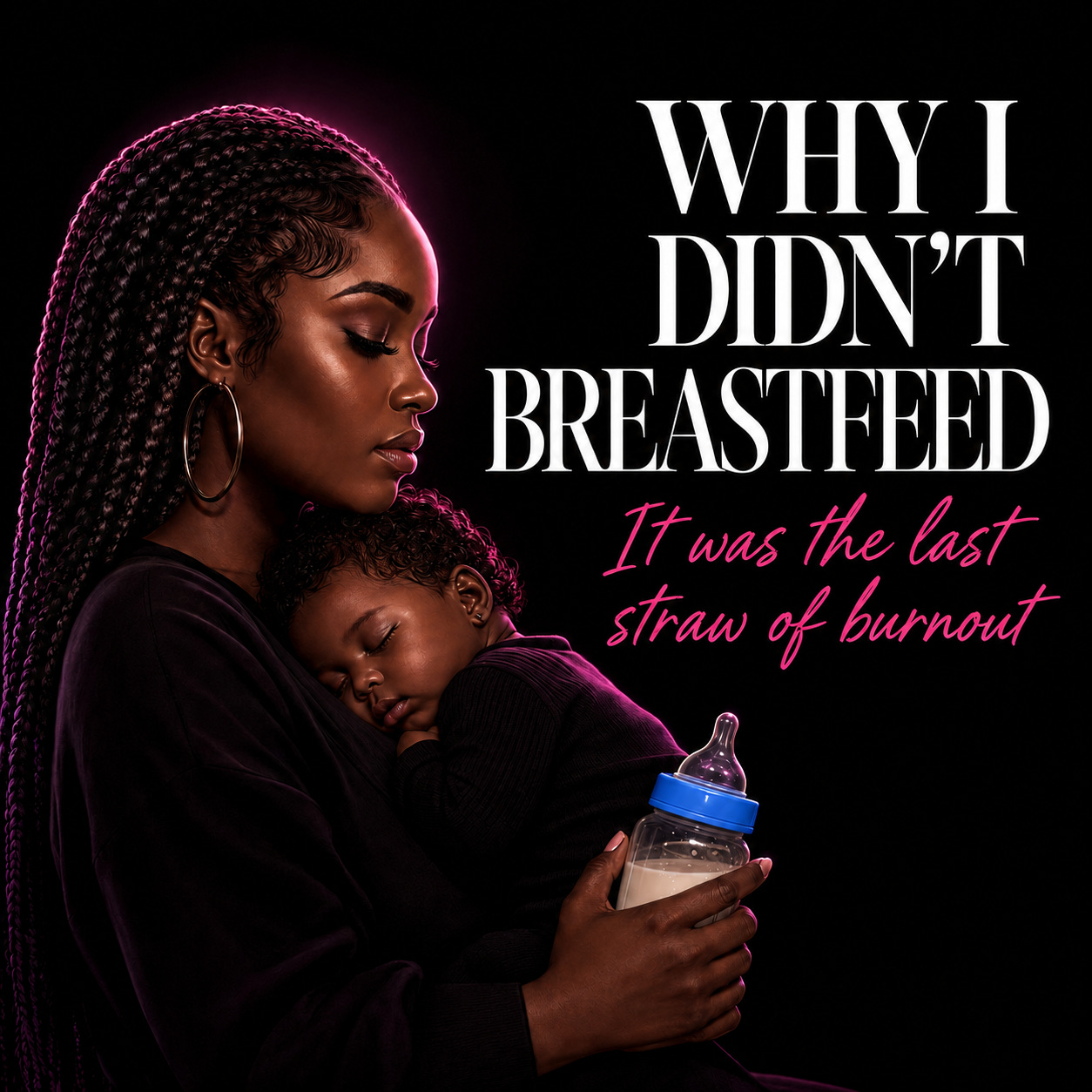
Breastfeeding was the last straw.
Not because breastfeeding is bad. Not because I didn’t understand the benefits. Not because I didn’t love my baby enough to try. It was the last straw because it represented one more way my body, time, energy, and identity were expected to belong to someone else.
Before I became a mother, I had already made the helper and healer my identity. I was the person who knew what to do. I could hold the crisis, organize the plan, make the decision, and help everyone else regulate. I taught people not to help me because I was always showing them that I could handle it.
Even when I couldn’t.
That identity required me to perform beyond my actual capacity. People became accustomed to me being the strong one, and I became accustomed to abandoning myself to remain her.
Then I had a baby.
Motherhood did not enter a soft, supported, well-structured life. It entered a life that was already being held together by my overfunctioning. There was no strong system waiting to catch me. There was no deep reserve of energy. There was no version of me who had been consistently cared for and could now pour from an overflowing cup.
There was just me, already exhausted, now responsible for keeping a tiny human alive.
And then came breastfeeding.
Latch the baby. Feed the baby. Pump. Track the ounces. Wash the parts. Try again. Worry about the supply. Question whether the baby is getting enough. Listen to everyone explain what is best while you are barely surviving what is happening inside your own body and mind.
Breastfeeding was being presented as another responsibility for me to carry perfectly. But I was no longer willing or able to keep proving that I could endure one more thing.
So I stopped.
And there may be people who think I should have tried longer, asked for more support, pushed through the pain, or sacrificed more. But sacrifice was not new to me. I had built an entire identity around it. I knew how to override myself. I knew how to ignore my needs and call it strength. I knew how to keep going long after my body and mind had asked me to stop.
What I did not know yet was how to choose myself without feeling guilty.
Not breastfeeding became one of the first decisions I made based on my actual capacity instead of the woman I thought I was supposed to perform as.
My baby needed to be fed. But my baby also needed a mother who could remain here. A mother who could sleep when possible, take her medication if needed, recover, ask for help, and begin building the systems that should have existed before the baby arrived. A mother who understood that keeping herself alive and emotionally present was also an act of care.
Formula gave me somewhere to put the pressure down.
It allowed someone else to feed my baby. It gave me one small opportunity to step outside the identity of being the only person who could provide what everyone needed. It did not solve my postpartum depression. It did not create support where support was missing. But it removed one demand from a life that could not safely hold another one.
I did not fail at breastfeeding.
I reached my limit and finally believed it.
That distinction matters because so many burned-out women have been taught that our limits are moral failures. We think needing help means we are incapable. We think changing the plan means we lacked discipline. We think choosing the option that preserves us makes us selfish.
It does not.
Sometimes the healthiest decision will not look like the most sacrificial one. Sometimes loving your child means refusing to disappear inside motherhood. Sometimes being a good mother means acknowledging that you are a human being with a nervous system, a body, a history, and a finite capacity.
My recovery from burnout began when I got honest about the life I had created and the identity that helped create it. I had taught people that I did not need help. I had built a life that depended on me performing beyond my ability. Postpartum depression exposed just how unsustainable that life had become.
Breastfeeding was not the cause of my burnout. It was simply the final demand I could not absorb.
Today, I am much clearer about who I am, what I do, who I can help, and who I am outside of being a healer. I am learning that I do not have to earn care by collapsing first. I do not have to prove my love through suffering. I do not have to abandon myself to be a good mother.
And neither do you
From the titleeeee, you got me Let me tell you something, I felt the same way. I had twins, and I had so much going on in my life at the time. Breastfeeding on top of everything probably would’ve completely drained me.